 Claddwell Bathroom Remodeling
Tub-to-Shower Conversion Boulder
A tub-to-shower conversion fits a specific moment: the household no longer uses the tub for soaking, the 60-inch alcove feels wasted, and the builder-grade surround is cracking at the grout joints. That moment arrives…
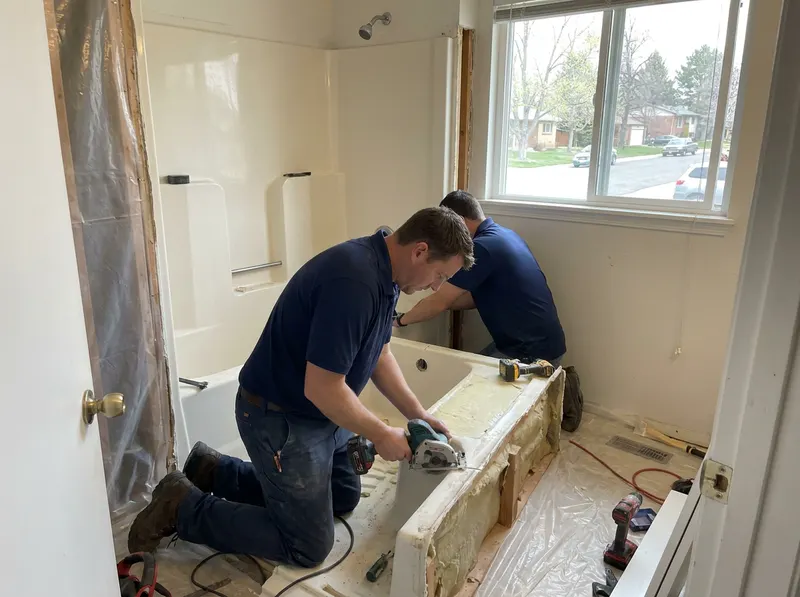
- Scope: demolition of the existing tub and surround, subfloor inspection and repair if needed, waterproof membrane installation (Schluter Kerdi or comparable), new drain rough-in, wall tile or panel system, shower valve and WaterSense-certified showerhead, and glass enclosure or curtain rod.
- Timeline: most single-bathroom conversions run 5, 10 business days from demo through final grout seal; homes with original 1960s, 1970s cast-iron plumbing (common in Mapleton Hill and Whittier) may add 1, 2 days for drain reconfiguration.
- Cost range: $4,500, $14,000 for a standard 30×60-inch alcove conversion in Boulder County; custom tile work, frameless glass, or barrier-free (curbless) configurations typically land in the $9,000, $16,000 range, exact totals confirmed after an on-site visit at no charge.
- What's removed: the tub, faucet deck, drain assembly, and existing surround tile or panels; Claddwell Bathroom Remodeling coordinates responsible disposal, and porcelain and cast-iron tubs can often be recycled through Earth911's material locator.
- How to book: call (303) 555-0147 to schedule a free on-site assessment, bring any photos of the existing bathroom and a rough sense of preferred materials so the visit is as useful as possible.
A tub-to-shower conversion fits a specific moment: the household no longer uses the tub for soaking, the 60-inch alcove feels wasted, and the builder-grade surround is cracking at the grout joints. That moment arrives frequently in Boulder's older neighborhoods, a 1958 ranch in Martin Acres, a 1970s split-level in Frasier Meadows, or a bungalow on the Mapleton Hill grid where the original bathroom has one tub and no shower at all. The conversion reclaims that footprint as daily-use space without moving a single wall.
Boulder's climate creates two technical requirements that generic conversion guides rarely address. First, the city sits at roughly 5,430 feet, where freeze-thaw cycling affects any moisture that migrates behind tile. The Schluter Systems waterproofing standard, a bonded foam or membrane assembly rather than traditional felt-and-wire, prevents that moisture migration at the wall plane, not just at the surface. Second, Boulder's municipal water utility operates at pressures that can vary block by block in hillside neighborhoods like Chautauqua and University Hill; a WaterSense-certified showerhead rated for the actual supply pressure in the home performs noticeably better than a catalog spec chosen without that check. Both details are confirmed during the on-site visit, not assumed from an address.
The decision between keeping a tub and converting it comes down to one honest question: does anyone in the household use the tub more than twice a year? If the answer is no, which is common in Gunbarrel townhomes and Holiday Neighborhood houses where a second full bath with a tub already exists, the conversion trades a rarely-used fixture for a shower that gets used every day. If the household includes young children or a resident who relies on soaking for mobility reasons, converting the only tub in the home is a trade-off worth examining before committing. Claddwell Bathroom Remodeling will raise that question directly during the assessment, because a conversion that creates a future problem is not a good outcome regardless of the tile selection.
For barrier-free (curbless) configurations, increasingly requested in Newlands and Goss-Grove homes where aging-in-place is a stated goal, the drain must be positioned at the low point of a sloped mortar bed, and the subfloor framing is often reinforced to carry the added weight of a linear drain assembly. The ADA's 2010 Standards for Accessible Design specify a 36×36-inch minimum clear floor space for a transfer shower and 60 inches for a roll-in configuration; those dimensions guide the rough-in layout even in non-ADA residential projects where future accessibility is a consideration. Tile selection for a curbless floor also follows the Tile Council of North America coefficient-of-friction standard, a minimum 0.42 wet COF for shower floors, which rules out large-format polished tiles regardless of how they look in a showroom. NKBA bathroom planning guidelines further inform fixture placement and clearance dimensions that affect daily comfort. Material sourcing for tile can be cross-referenced with Green Building Advisor for embodied-carbon context, and Boulder's Building Safety division issues the required permit for any drain relocation, Claddwell Bathroom Remodeling pulls that permit as part of the project scope. For plumbing fixture standards, the International Association of Plumbing and Mechanical Officials (IAPMO) publishes the Uniform Plumbing Code that Colorado has adopted, which governs drain sizing and venting for the new shower configuration.
Tub-to-Shower Conversion cost in Boulder
Every job gets a firm, written price after a free on-site visit.
Common questions
Does a tub-to-shower conversion in Boulder require a permit?
Will removing the only tub in a Boulder home hurt resale value?
How long does a tub-to-shower conversion take in Boulder?
What tile works best for a shower floor in Boulder's climate?
Can a tub-to-shower conversion be made barrier-free in a Boulder home with a wood-frame floor?
For standards, safe disposal, and service guidance on Bathroom Remodeling in Boulder, CO, useful references include U.S. Dept. of Energy, ENERGY STAR, HUD, OSHA, U.S. Green Building Council, and Google Maps. General consumer and small-business resources are available from USA.gov, Better Business Bureau, FTC Consumer Advice, U.S. Small Business Administration, and Ready.gov.
Get started today
Tell us about your tub-to-shower conversion job in Boulder and we'll send a clear, written quote, usually the same day.